 VIDEO : Sister of Christ, who is your God ?
Ongoing Formation PROVINCE OF MADAGASCAR
Ongoing Formation PROVINCE OF MADAGASCAR
“Participating in the mission of Christ”; is the third part of the orientations of the 9th General Chapter 2022. In order to appropriate this dynamic and spirit of the Chapter, the province of Madagascar organized, during the four weekends of October, a session entitled “Missiology,” intended for all the sisters.
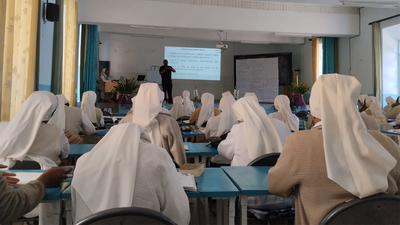 It took place in Alakamisy, Ambohimaha, Antsirabe, Ambatolampy and Amparibe. The Ongoing Formation Team was able to take advantage of the month of October, dedicated to the universal mission, and the highlight of our 50-year jubilee. The formation was led by Fr. Randrianasolo Charles Arsène, diocesan priest of Fianarantsoa and Vice-Rector of the UCM.
« THIS PARTICULARLY ENRICHING TRAINING GIVES RISE TO A REAL RENEWAL IN US... »
Starting from the etymology of the term “mission”;, several essential themes are addressed.
The three stages of mission in the New Testament were presented: Jesus sent by the Father, the apostles sent by Jesus and, finally, the mission of the Church, insisting on the mission of evangelization of Saint Paul. From these foundations, three epochs of the missionary impulse are also exposed: the mission of the Church in the first three centuries, the missionary work of the monks as well as the missionary impulse of the 16th century. Missiology is therefore to be understood in its triple dimension: theoretical, historical and theological.
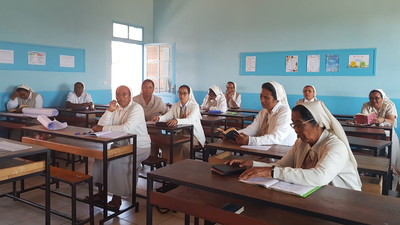 The analysis of the documents of the magisterium, particularly those of the Second Vatican Council as well as certain texts of Saint John Paul II and Pope Francis, has made it possible to shed more light on the current challenges of the mission. Chapter 7 of Lumen Gentium insists on the missionary character of the Church, called to lead humanity towards the fullness of Christ, her Head. The Trinitarian origin of God’s mission is rooted in the fulfilment of God’s plan of salvation in human history (cf. Eph 1:10; 3:2-9; Col 1:25). The mission thus appears as a response to the Father’s plan, a continuation in the Son’s mission and a contemporary collaboration with the Holy Spirit.
The nature and content of the Church’s evangelizing mission were also specified: witness to the Christian life, proclamation of salvation, preaching of hope, commitment to just liberation and human promotion, rejection of violence. While the fundamental principles and content remain immutable, the means of evangelisation adapt with time, place and culture. To carry out this mission, three essential attitudes are required: the spirit of openness (going out), the spirit of renewal (aggiornamento) and the spirit of discernment (sign of the times).
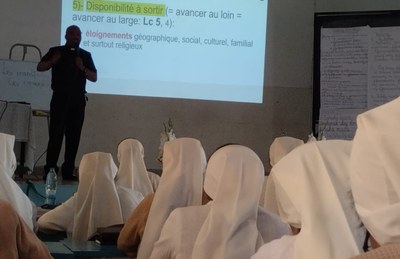
Six criteria are required for an authentic missionary: 1- God’s call with natural qualities such as health, intelligence, practicality, etc. 2- the free and generous response, 3- the confirmation of the Church, 4- the sending of the Church in the name of God, 5- the readiness to go out (geographical, social, cultural, family, religious), 6- apostolic charity and apostolic zeal. It is a question of letting oneself be led by the Spirit, of cultivating acceptance and docility to the Spirit, of living the mystery of Christ and communion with him, sent by the Father, of accepting self-denial and of loving the Church and men like Jesus.
These are the essential points that we retain from this particularly enriching training. It has given rise to a real renewal for the apostolic year that has barely begun by reaffirming that we are all missionaries by virtue of our baptism, wherever we are sent.
Ravaoarisoa Voahanginirina Claire